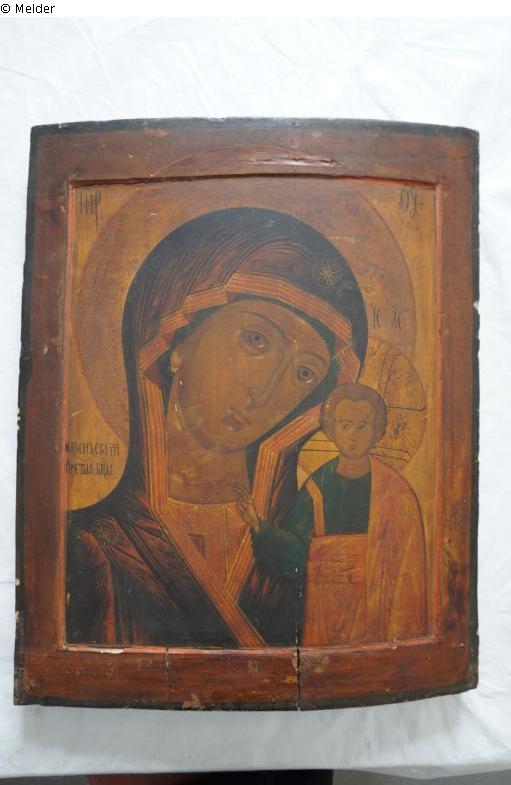
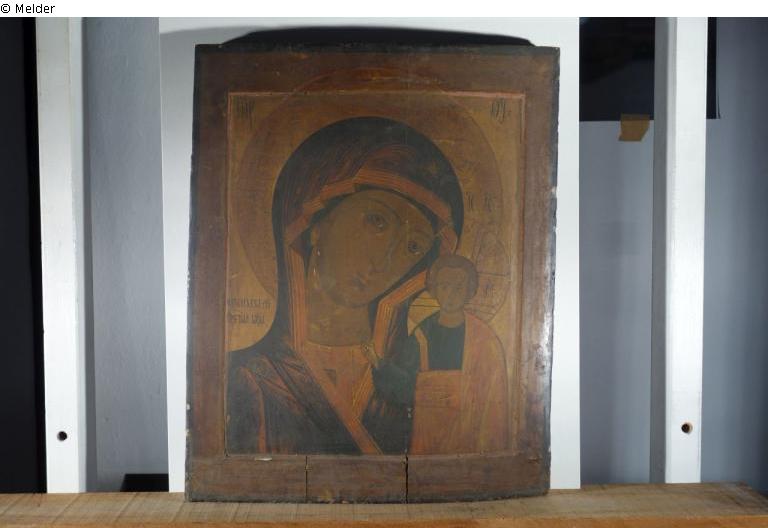
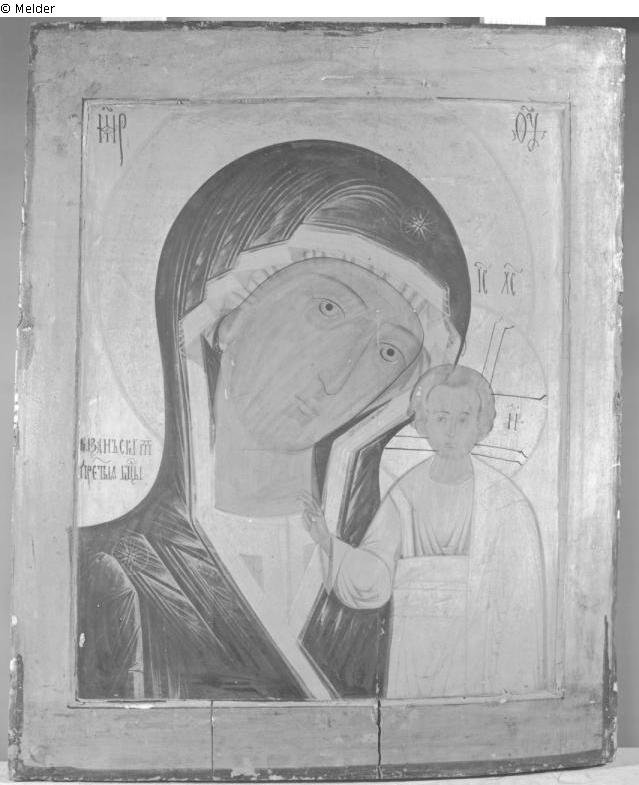
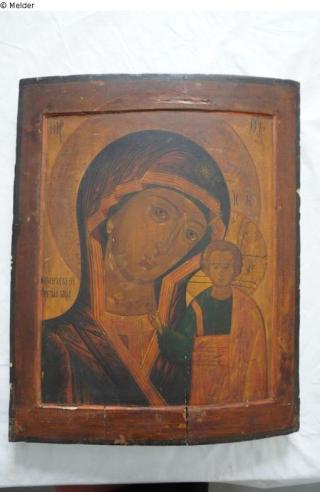
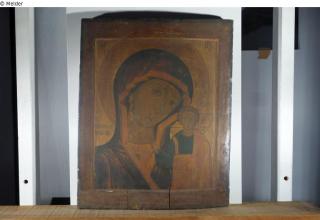
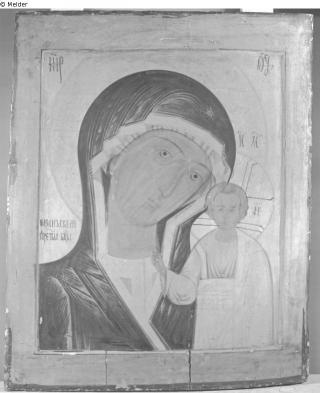
"The Mother of God of Kazan is the most common motif in Russian church art. Starting from an original in the city of Kazan, millions of copies in various forms have been made over the centuries. The present copy is a very typical representation. Although it lacks silver or gold mouldings, the artistic execution from the 19th or possibly early 20th century is very fine. In places the painting (a mixed technique with a wax component) is relief-like and stencilled on. The background is not gilded, but executed in ochre.
The depiction, which is mainly known in the Russian region, shows the bust of the Mother of God. She bows her head towards Christ, who stands upright on her left side and raises his right hand in blessing, while the left is covered by his robe. The inscription in old Church Slavonic reads "Holy Mother of God of Kazan" the four letters in Mary's halo represent the "Jesus Christ" below. In his halo, too, there are usually three letters that identify him. On this image, however, two are covered by the image of Mary. Further abbreviations are found in the two upper corners of the image which stand for "Mother" and "God" and also correspond to the historical model of the icon from Kazan.
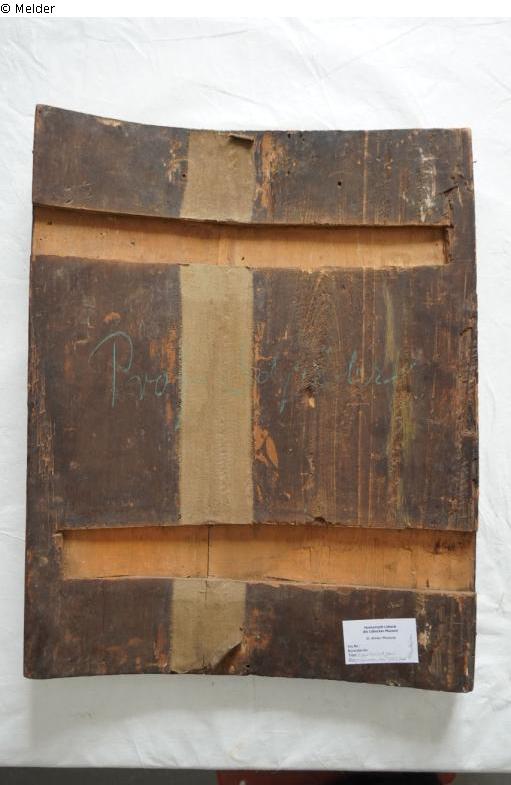
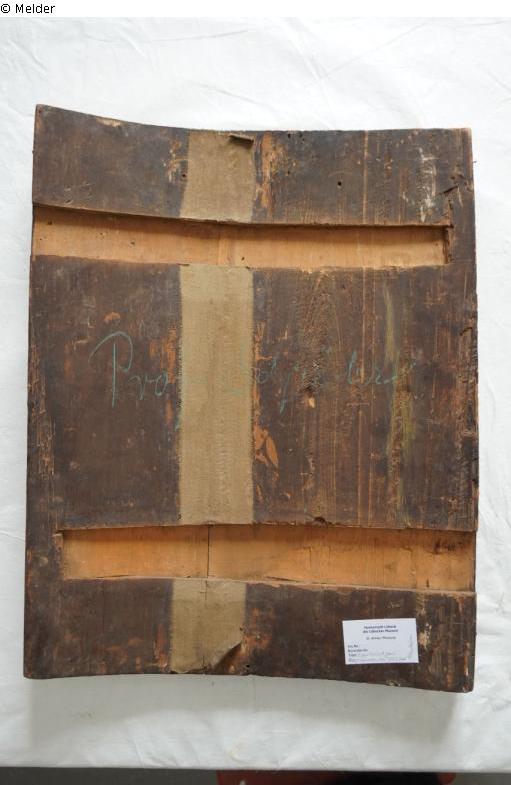
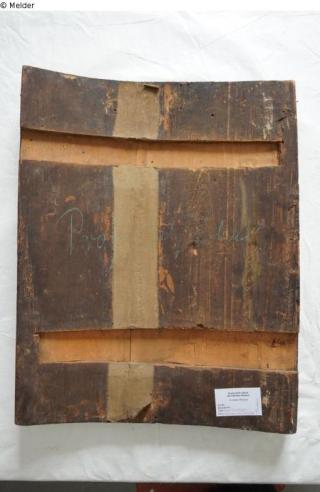
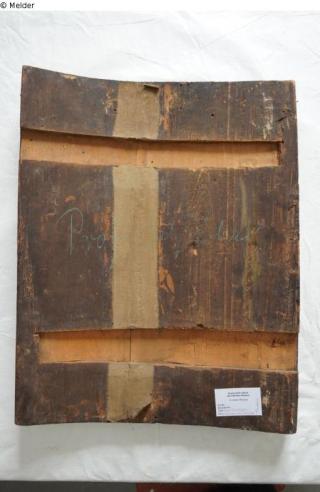
The wood (altogether up to 3.5 cm thick) consists of three layers, a layer about 7 mm thick which was probably only glued on as an outer framing, a layer of wood about 4 mm thick on which the painting lies and a good 2 cm thick "doubling up" to the back. It is not clear whether this was originally intended or whether the panel was thinned and reinforced later; the sides are framed. On the reverse side there are two recesses of previously inserted sliding strips. It can be assumed that the panel was once part of an iconostasis."